
Addresses with context.
A virtual address and a file offset describe different locations. Hexvoyant keeps both visible and reports when a mapping is missing or ambiguous.
About the creator
Creator of Hexvoyant
I'm building Hexvoyant, an independent student project in binary analysis. It brings the structure inside compiled programs into a local workbench for macOS.
Independent project · Source alpha
The work
Hexvoyant makes compiled programs easier to explore, bringing instructions, strings, and references from Mach-O, PE, and ELF files into one local workbench.
My focus is making those connections clear—from a function to its bytes. Built with Rust, the macOS app is in source alpha. See the roadmap for what's next.
In the details
A virtual address and a file offset describe different locations. Hexvoyant keeps both visible and reports when a mapping is missing or ambiguous.
Function graphs connect blocks of instructions. Zoom, pan, and linked selections help turn a dense graph into something you can explore.
Results carry warnings and coverage information. Skipped or partial analysis stays visible, so a finding can be read with its limits.
Inside the workbench
The demo uses a small C program included with the project. Follow addresses, inspect strings, and export its recorded analysis directly in your browser.
Explore the recorded demo Try the native app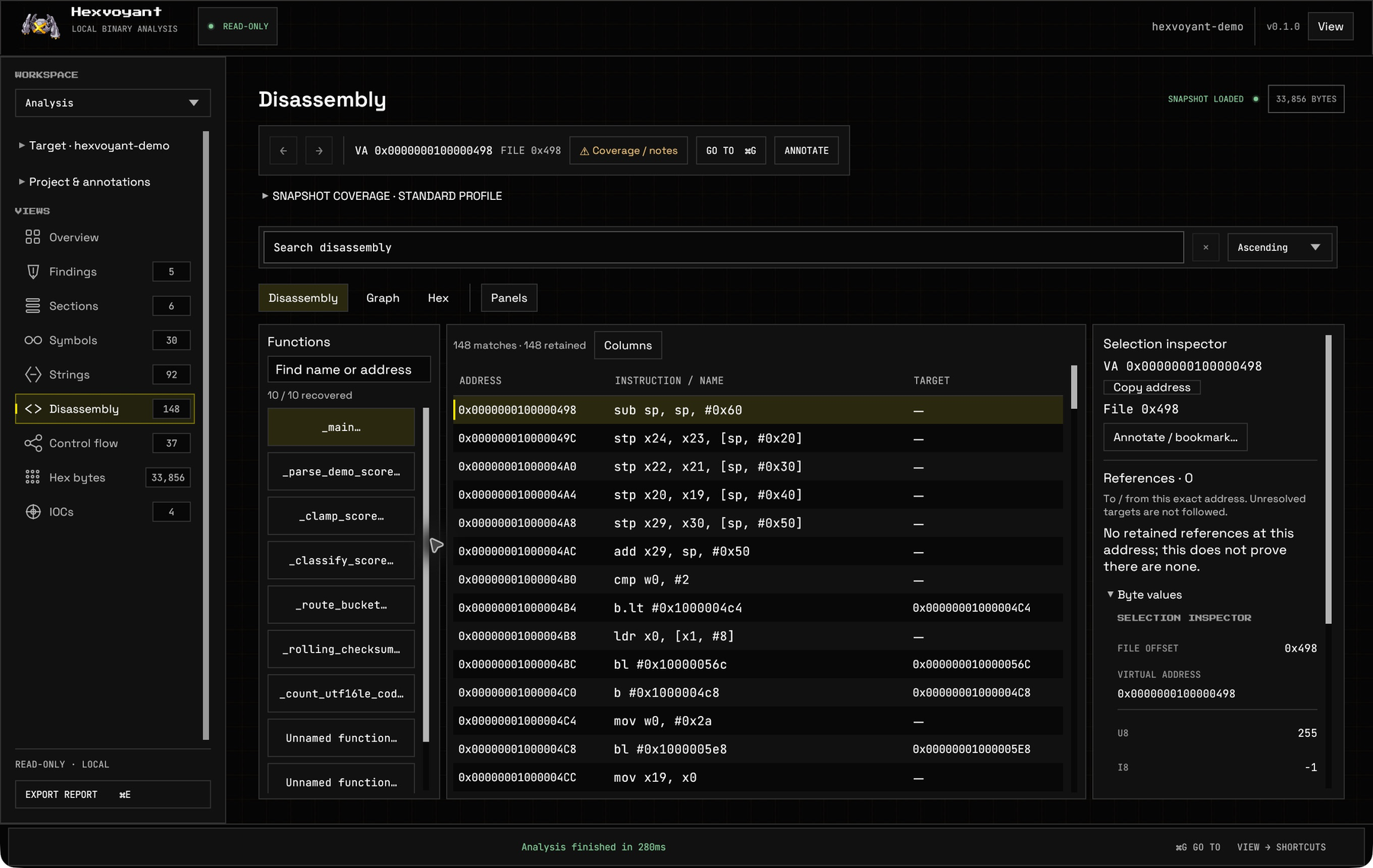
Keep in touch
Find me on LinkedIn for conversations about Hexvoyant and the work behind it.